Application · Cold-chain temperature
No. A sealed metal cold room is basically a Faraday cage — but you don't fight the metal, you hop over it. Put a node inside on the sensor and a relay right at the door; the self-healing mesh carries the reading out of the box and straight to your SCADA.
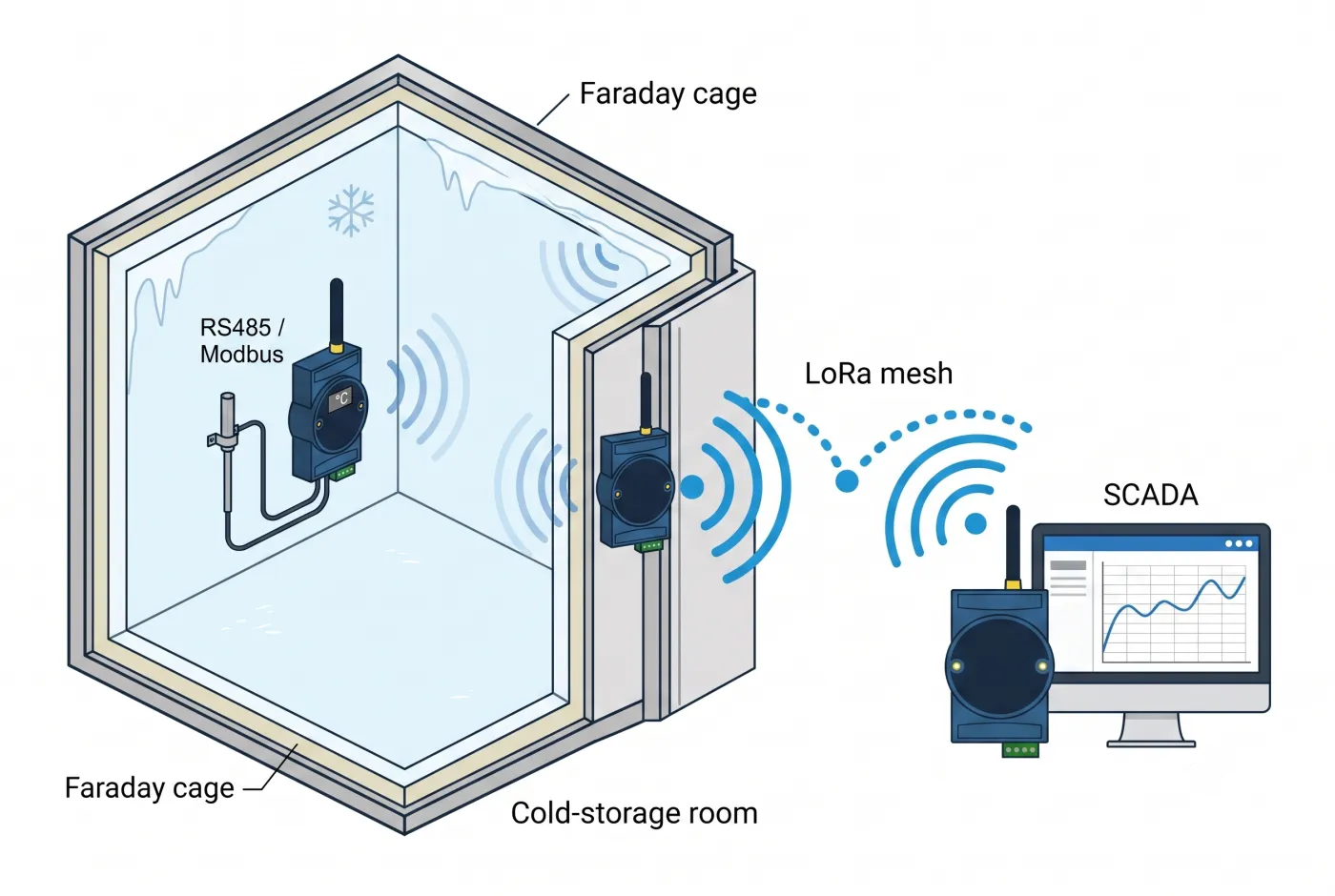
A cold storage or freezer room has to log its temperature continuously — for food safety, pharma, or GDP compliance. But the room was never built with an external temperature feed. Getting a signal out of a sealed, insulated metal box is hard, and running a new cable means cutting through the insulated panel — which breaks the seal, invites condensation, and can mean re-certifying the room.
A node inside, a relay at the door, straight into SCADA.
A cold-rated Siliqs node reads the temperature/humidity sensor (RS485 / Modbus or probe) and timestamps each reading.
A second node at the door gap or just outside relays the reading over the mesh — the signal only has to reach that one node to escape the metal box.
A gateway forwards the data as Modbus-TCP or MQTT — the same feed your SCADA already reads. No new dashboard to learn.
Then you move the relay closer to the gap — and that's the whole answer.
Put a sensor node inside and a relay node at the door or just outside. Siliqs nodes mesh by default, so the reading hops from the inside node to the door node and out — no cable through the panel, nothing to configure.
Metal and insulation attenuate any radio, so from deep inside a single hop can be marginal. That's exactly why the mesh matters: a relay at the door gap catches the leaked signal and carries it out. You add a hop instead of fighting the metal.
Yes. A gateway hands the data to your SCADA as Modbus-TCP or MQTT — the same kind of feed it already consumes.
No. The link out of the room is wireless, so the panel stays intact — no broken seal, no condensation path, no re-certification because of a new penetration.
Yes — it's industrial-grade. The probe sits in the cold zone and the electronics are specified for the environment.
Yes. Each room's nodes join the same mesh and report to one gateway, so all rooms land in one place.
Tell us the sensor, the room, and where your SCADA lives. We'll tell you straight how to get the reading out.