Application · Multi-site metering
Mesh is built for exactly this. Each meter gets a node; the nodes self-organise into one mesh across the whole site, each also relaying for the others; every reading lands at one collection point. Coverage grows as you add nodes — no trenching, no per-point SIM, no internet required.
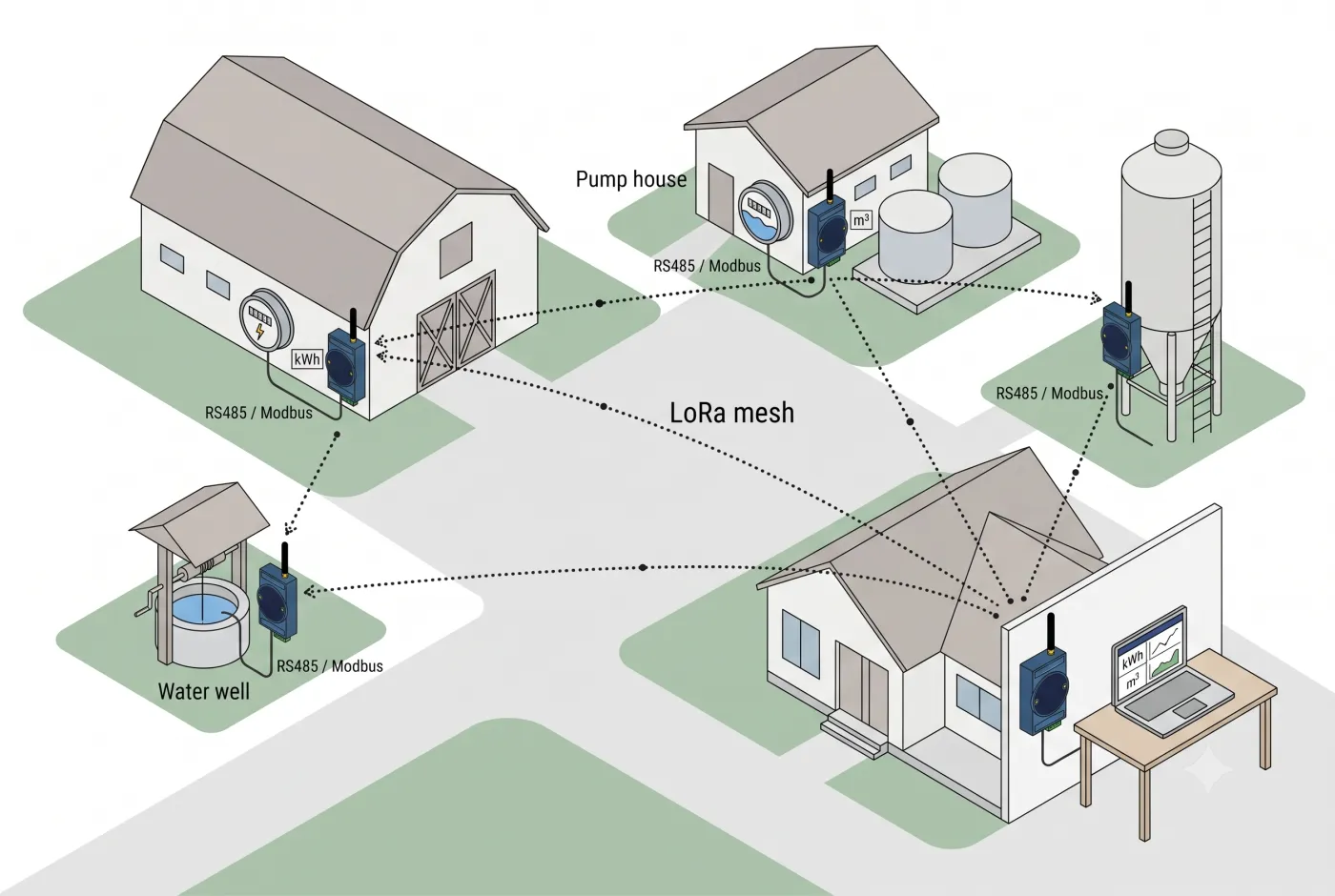
A farm — say a pig farm — has meters scattered across the site: power at each barn, pumps and blowers, a water meter at the well, feed silos. The owner wants every reading in one dashboard to see consumption and spot problems. Trenching signal cable across a working farm is absurd; a cellular SIM at every point is expensive and flaky; and the site's internet, if any, is patchy.
A node per meter, one mesh across the site, one place to read it.
Each node reads its meter over RS485 / Modbus — power, water, whatever the meter exposes — and reports on a schedule you set.
The nodes form a single self-healing mesh, each relaying for the others. Coverage grows as you add nodes — no link to engineer, no map to draw.
A gateway at the office collects everything and feeds a dashboard, MQTT, or a local log. Internet is optional — it can log on-site with no connection at all.
You drop in a node — and that's the whole answer.
Put a node at each meter. The nodes form one self-healing LoRa mesh across the site and report to a single gateway — no cabling between points, and each node relays for the others.
Each hop reaches hundreds of metres in the open, and a message can travel up to 7 hops — the Meshtastic maximum — which crosses most sites. To reach a far corner you add a node in between; if a site is larger than 7 hops across, you place another gateway to start a fresh segment rather than chaining endlessly.
No. The gateway can log everything locally with no connection. Internet is optional if you also want a cloud dashboard.
Yes. Any meter with an RS485 / Modbus interface works — power, water, and others all join the same mesh.
They're low-power. Run them from mains where there's an outlet, or from solar/battery where there isn't.
A single mesh comfortably handles tens of nodes, with a practical ceiling around 100 (the Meshtastic node database on this hardware caps at 100). For a larger site you run more than one mesh, each with its own gateway, all feeding one dashboard — it scales by segmenting, not by endlessly growing a single mesh.
Tell us roughly how many points, how far apart, and what you want to read. We'll sketch the mesh with you.