Application · Modbus integration

“Our SCADA only speaks Modbus RTU — it doesn't know how to wait for a mesh to answer.”

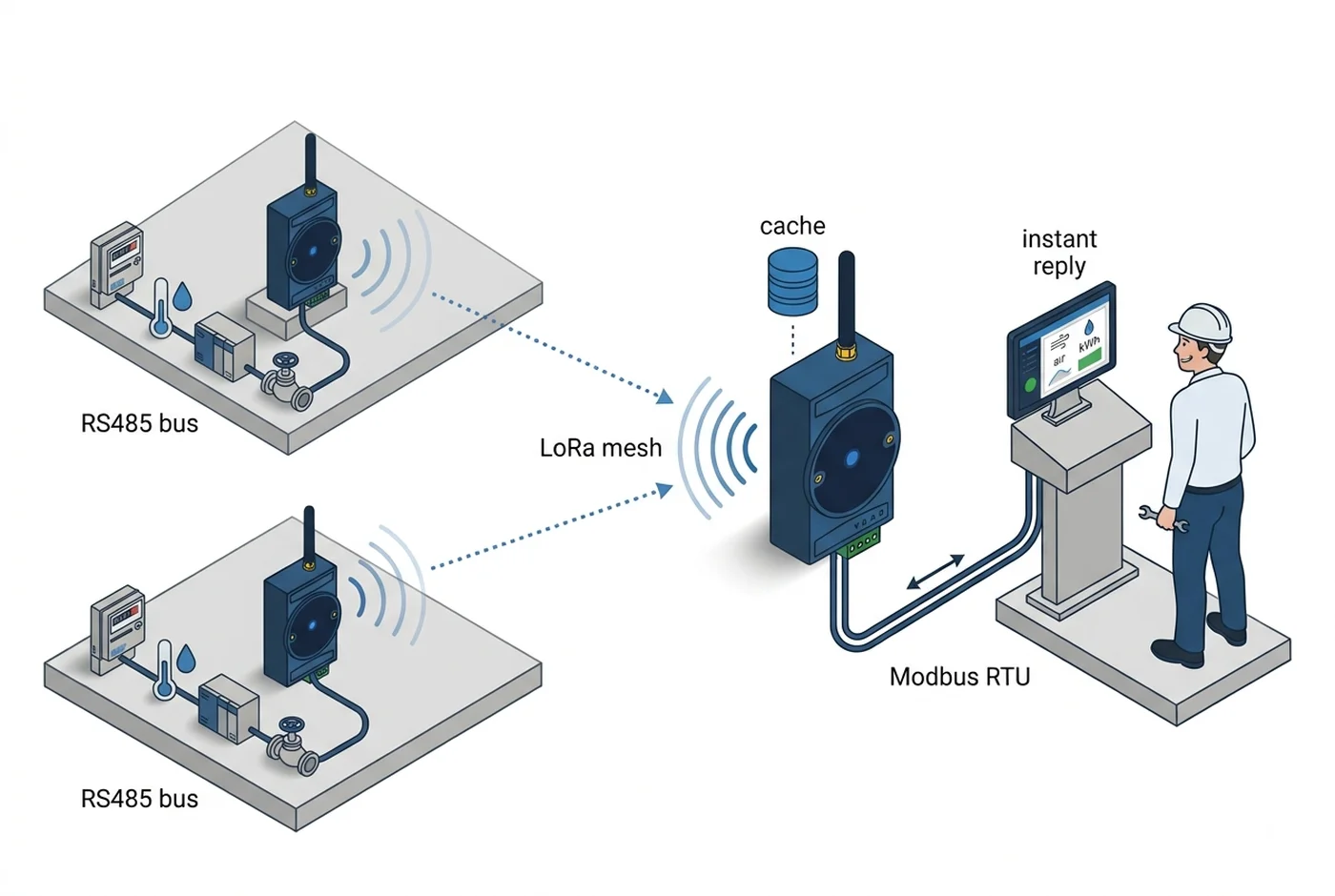
Each remote node is a Modbus master for its own whole RS485 bus — one node, many devices — reporting over a private LoRa mesh on its own schedule, not on demand. A Siliqs gateway node listens to that mesh and keeps the latest reading from every device on every bus in a local cache. Your existing Modbus master polls the gateway exactly like any RS485 slave and gets an answer right away, in the same protocol it already speaks — no mesh round-trip, no new software.
Standard Modbus RTU Instant reply Staleness-checked
Illustration: two RS485 buses, each carrying several Modbus devices behind one SQC485Iv2 node, reporting over a private LoRa mesh to a gateway node with a cache, which answers an existing Modbus RTU master instantly

The situation

A site has RS485/Modbus devices spread across places too far apart to share one wired bus — different buildings, different floors, opposite ends of a yard. Whatever CAN share a bus, does: one Siliqs node masters a whole run of RS485 devices at each location. It's only the distance BETWEEN locations that a wire can't cross — that gap is what the private LoRa mesh carries instead. That solves the reach problem. But the SCADA, PLC or historian that's supposed to consume this data was built for one thing: send a Modbus RTU request over a wire, get a reply back in milliseconds. It has no idea a mesh is even involved, and no patience for one.

Why the usual answer is blocked

The concern
“Our polling software sends a Modbus read and expects an answer right away. It doesn't know ‘wait a few seconds for a radio to reach a sensor and come back' — it just times out.”
A live round-trip doesn't fit
Even a fast mesh hop takes real time, and telemetry already arrives on its own periodic schedule — seconds to minutes. Making the master wait for a fresh, on-demand round-trip every single poll would still be slow, and would compete with the mesh's own reporting traffic.
What's actually needed
An answer that shows up instantly, in the exact protocol the master already speaks, built from data that's already fresh enough for how often it's being polled.

How Siliqs solves it

One node listens to the mesh and holds a cache; your master keeps talking to it like any other slave.

The gateway caches every reading as it arrives

One Siliqs node runs in gateway mode. It doesn't poll — it just listens to the mesh and keeps the latest reading for every device on every other node's RS485 bus, ready to hand out.

Your existing master gets an instant Modbus RTU reply

Your SCADA or PLC polls the gateway over RS485 exactly like any Modbus slave. It gets the cached reading back immediately — no waiting on the mesh, no change to your polling software.

Two addressing modes — pick what fits your poll list

Transparent: the gateway answers under each remote sensor's own original slave address — drop it in without touching your existing poll list. Aggregated: several sensors' readings sit under one shared slave address at different register offsets, when adding one device to your SCADA beats adding many.

How it's wired: one bus per node, one mesh, one gateway

One node masters a whole RS485 bus · instant Modbus RTU reply from cache RS485 bus — several devices, one node Node A RS485 bus — several devices, one node Node B cache Modbus RTU — instant reply SQC485Iv2 — Gateway Your existing SCADA / PLC Many devices per node, many nodes per gateway — one RS485 connection reads it all

Why the reply is trustworthy, not just fast

Its limits are stated up front. What it won't quietly do is what makes it safe to poll.

Freshness is enforced, not assumed
Every cached reading carries a staleness threshold. Ask for a value older than that and you get a proper Modbus exception, not a silently outdated number.
Standard protocol both ends
Ordinary FC03/FC04 register reads and standard Modbus exception codes — nothing proprietary for your existing poller to learn.
Read path only
The gateway reflects the mesh's latest telemetry. It is not a control path back into a sensor or machine.
Honest about the tradeoff
The reply is instant — the data behind it is only as fresh as the sensor's own reporting interval. This suits periodic telemetry polling, the same way the rest of the mesh does; it is not a substitute for a live, real-time read.

What you actually need

Sensors
Any RS485/Modbus sensor already on a Siliqs mesh node — nothing changes on the sensor side.
Gateway
One more SQC485Iv2, set to gateway mode, wired to your existing RS485 bus.
Your master
Unchanged. Same Modbus RTU poll, same protocol — potentially even the same slave addresses, in transparent mode.
Firmware
SQC485Iv2 firmware v1.4.0 or later.
Good fit for
SCADA, PLCs or historians that already poll Modbus RTU and just need to reach sensors spread too far apart to wire together.
The node
SQC485Iv2 — LoRa RS485 industrial node.

Questions people ask

Does our SCADA need any changes?

No. It polls the gateway with ordinary Modbus RTU, over RS485, the same way it polls any slave today.

How fresh is the data I get back?

As fresh as the sensor's own mesh reporting interval. A configurable staleness threshold guards it — ask for a reading older than that and you get a Modbus exception, not stale data handed out silently.

Can I keep using the same slave addresses?

Yes — that's transparent mode. The gateway answers under each remote sensor's own original address, so an existing poll list doesn't need editing.

Can several sensors share one slave address instead?

Yes — aggregated mode. Several sensors' readings sit under one shared slave address, each at its own register offset, so your SCADA only needs to add one device.

Can it write commands back to a sensor or machine?

No. This is a read path — the gateway reflects the mesh's latest telemetry, it doesn't relay writes or control commands.

What happens if a sensor drops off the mesh entirely?

Its cached reading keeps aging. Once it passes the staleness threshold, your master gets a clear Modbus exception instead of silence or a stale number — you find out, instead of quietly polling old data.

Need your existing SCADA to reach sensors spread across a site?

Tell us what your master already polls, how many sensors, and how fresh you need the data. We'll scope a gateway with you.