Application · High-security / non-IP
LoRa isn't IP. A read-only node on each machine sends its readings over a private LoRa mesh to a dedicated gateway — a separate path that never touches your network. Low-rate telemetry with a tiny attack surface, which sidesteps the IT security review that blocks IP devices.
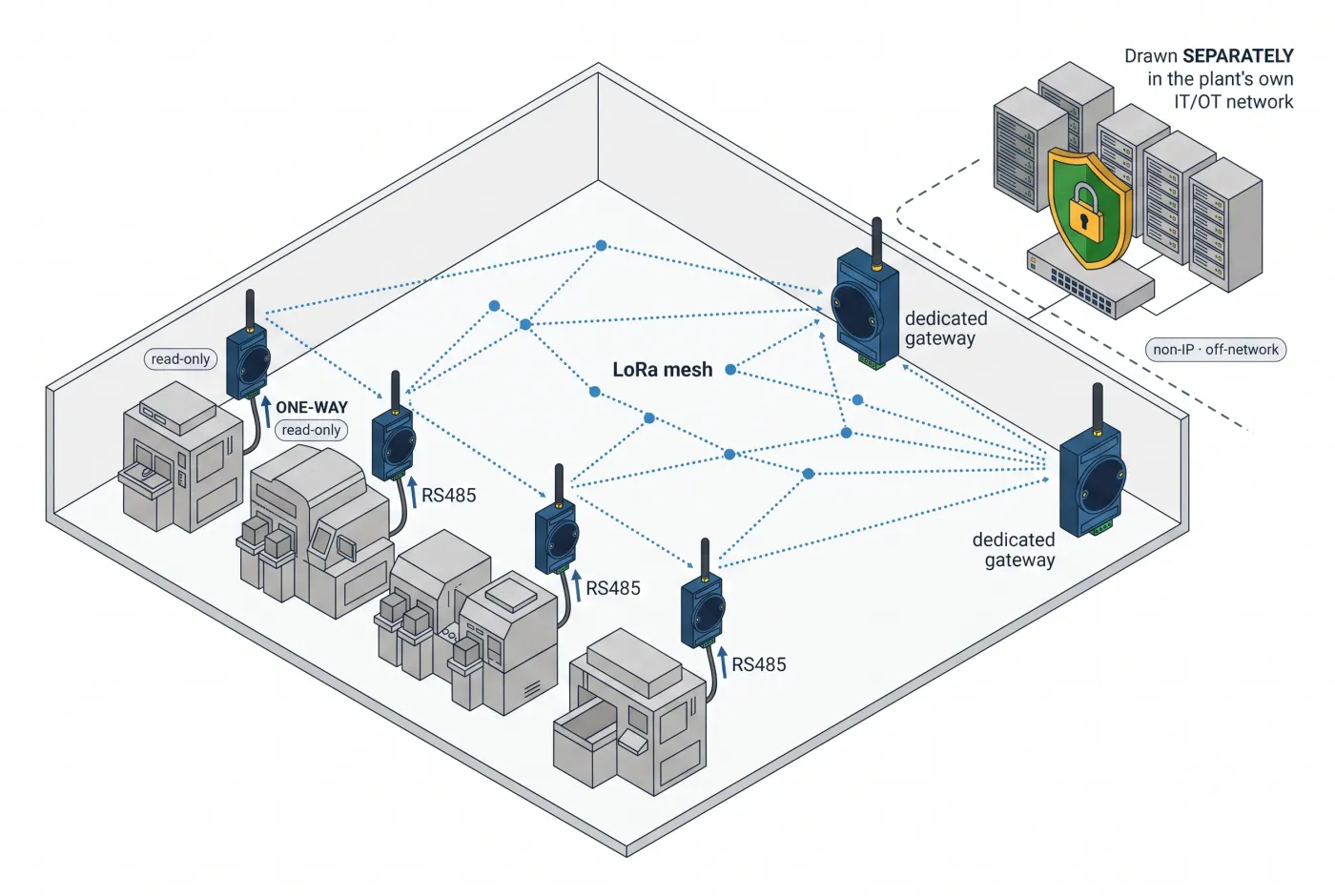
A high-security plant — a semiconductor fab, for example — runs a strict policy against adding networked equipment. Any new Ethernet or Wi-Fi device is an attack surface, so it triggers a heavy security review, and often it's simply refused. Yet the operation still needs to monitor many machines: status, temperature, cycle counts, utility draw. The usual IP-based answer is exactly what's not allowed.
Read-only at the machine, a private mesh, a gateway you control.
The node reads the values you're allowed to read over RS485 / Modbus — status, temperature, counters, utility draw. It reads; it doesn't write back to the machine.
Data leaves over a separate RF mesh — not your LAN, not your OT network. The nodes self-organise and self-heal across the floor.
A dedicated, physically separate gateway hands the telemetry to your own dashboard or SCADA — on your terms, on a path you decide, isolated from production.
Its limits are the point. What it can't do is what makes it safe.
To be clear: anything attached to a machine still deserves review — but the review is “a read-only, non-IP, offline sensor,” not “another IP node on our network.” That's a very different, much smaller conversation.
Yes. LoRa isn't IP. A read-only node on each machine sends over a private LoRa mesh to a dedicated, isolated gateway — nothing with an IP stack ever touches your network.
This link is read-only, low-bandwidth, non-IP and physically separate from your network — a very small attack surface. Nothing is exposed to your LAN or OT network, and it can run air-gapped.
No — honestly, it's slow. LoRa mesh carries low-rate telemetry, seconds to minutes per reading. It's right for monitoring, not for video or real-time control.
No. It works fully offline / air-gapped. The gateway is dedicated and you decide what, if anything, it connects to.
Yes — via a gateway you control, on a separate path. The telemetry reaches your dashboard or SCADA without joining your production network.
A single mesh handles up to around 100 nodes (the Meshtastic node database on this hardware caps at 100, with ~80–100 comfortable in practice). For more machines you run additional meshes, each with its own dedicated gateway, all reporting to your monitoring — it scales by segmenting.
Tell us what you need to read, how many machines, and your security constraints. We'll scope a non-IP path with you.