Application · Project rescue

“The contractor who built our monitoring system left it half-finished and disappeared. Can anyone take it over?”

Yes — and you probably don't have to reverse-engineer their black box. The field devices are almost always standard RS485 / Modbus, so a fresh Siliqs node reads them directly, independent of whatever the old contractor built. The data comes out over an open mesh, everything is set up in a browser, and the protocols and tools are open — so you finish the project, own it, and never get orphaned again.
No vendor lock-in Standards-based Finish incrementally
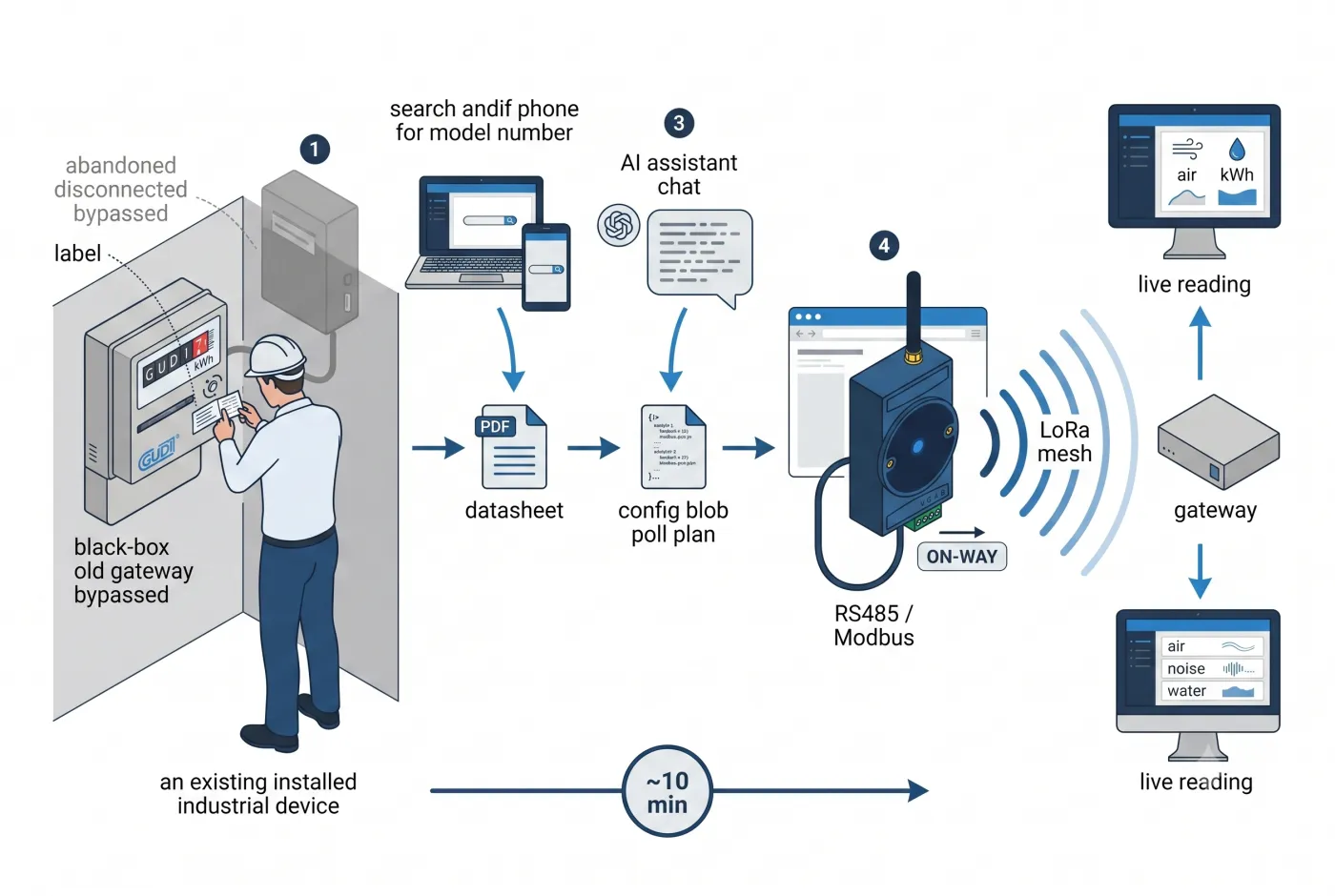
Diagram: taking over an orphaned project over a LoRa mesh — label, datasheet, config, live in minutes

The situation

A monitoring or automation project was half-built when the original contractor — the system integrator who installed it — went out of business, walked away, or simply stopped answering. What's left is a partial installation with no documentation, no source code, and no passwords. Some points still report, some are dead, and nobody will touch it because nobody understands it. The project is an orphan.

Why it feels hopeless

The fear
“There's no documentation, no source code, and the one person who understood it is gone. Do we have to rip it all out and start from scratch?”
Part 1 — you rarely need the old system
The good news: you usually don't need the previous contractor's system at all. The field devices — meters, sensors, most PLCs — almost always speak standard RS485 / Modbus. That interface didn't leave with the contractor.
Part 2 — bypass the black box, don't decode it
This is the point. A fresh Siliqs node connects straight to those devices and reads them independently — so you bypass the abandoned, undocumented parts instead of trying to reverse-engineer them. And because the protocols and tools are open, you're not handing yourself to another single vendor.

How Siliqs solves it

Read the devices fresh, bring them out on open standards, hand you the keys.

Read the field devices directly

A Siliqs node connects to an existing meter, sensor or PLC over its standard RS485 / Modbus port and reads it fresh. It doesn't need to know anything about the old contractor's system.

Bring it out over an open mesh

The readings come out over a self-healing LoRa mesh — standard and documented, not a proprietary gateway only one company can service.

Own it, in a browser

Configure, extend and maintain it yourself — or with any integrator — using free browser tools. No source code to inherit, no single vendor to depend on.

How a field engineer takes over one device — in about 10 minutes

No original contractor, no passwords, no source code — just the label on the device.

  1. Read the brand and model off the device's label.
  2. Search the model and download its datasheet — the Modbus register map.
  3. Paste the datasheet into an AI assistant (such as ChatGPT) and have it generate the config blob — the poll plan.
  4. Load it into the SQC485Iv2 in the browser and read the values back to confirm. The point is live.

So you're never orphaned again

The reason this project became an orphan was lock-in. The fix is openness.

Open protocols
Modbus is an open industrial standard; the mesh runs open-source Meshtastic. Nothing here is a secret only one company holds.
Free, documented tools
Flasher, Configurator and Gateway are free and documented, and the Gateway is open-source. What you set is yours to read back and change.
Anyone can maintain it
Because it's standards-based, any competent integrator can take it over — you're not locked to us, either. That's the opposite of how you got orphaned.
Finish incrementally
Recover the working points first, then finish the parts that were never wired — node by node, no big-bang rip-and-replace.

What you actually need

Field devices
Any meter, sensor or PLC that exposes a standard RS485 / Modbus interface.
What we don't need
The previous contractor's passwords, source code or documentation. We read the devices fresh and independently.
Devices
One node per point you want to recover or finish + one gateway. Add more onto the same mesh over time.
Setup
Point-and-click in a web browser — no programming.
Honest note
We bring a fresh, independent path to anything speaking standard RS485 / Modbus. A device that's entirely proprietary and closed may need replacing — we'll tell you straight after a look.
The node
SQC485Iv2 — LoRa RS485 industrial node.

Questions people ask

Our contractor abandoned a half-finished monitoring project — can it be taken over?

Usually yes. The field devices almost always speak standard RS485 / Modbus, so a fresh Siliqs node reads them directly and brings the data out over an open mesh — you bypass the abandoned system instead of decoding it.

We have no documentation, source code or passwords from the previous contractor — is that a problem?

Usually not. Siliqs reads the devices fresh and independently, so it doesn't need the old system's internals. What matters is the device's standard interface, which is still there.

How do you configure a device when you have no settings for it?

You don't need the old settings. Read the brand and model off the device's label, download its datasheet (the Modbus register map), and have an AI assistant such as ChatGPT turn that into the config blob. Load it into the node in the browser and read the values back to confirm — often under ten minutes per device.

Do we have to rip everything out and start over?

No. You reuse the field devices and finish incrementally — recover the working points first, then complete the parts that were never wired, node by node.

How do we avoid getting locked in and orphaned again?

Openness. Modbus is a standard and the mesh runs open-source Meshtastic; the tools are free and documented, and the Gateway is open-source. Any competent integrator can maintain it — you're not locked to us either.

What if the old system's devices are proprietary and closed?

Anything that exposes a standard RS485 / Modbus interface we read directly. A device that's entirely closed may need replacing — we'll look and tell you straight which is which.

Can you also finish the points that were never wired?

Yes. Add a node at each unfinished point; it joins the same mesh, so recovering and completing the project happen the same way.

Inherited an orphan project?

Tell us what's installed and what's dead, and which devices you can still identify. We'll tell you straight what can be recovered.