Application · Rooftop solar

“The solar hot water system is up on the roof. Can I see it — and control it — from inside the house?”

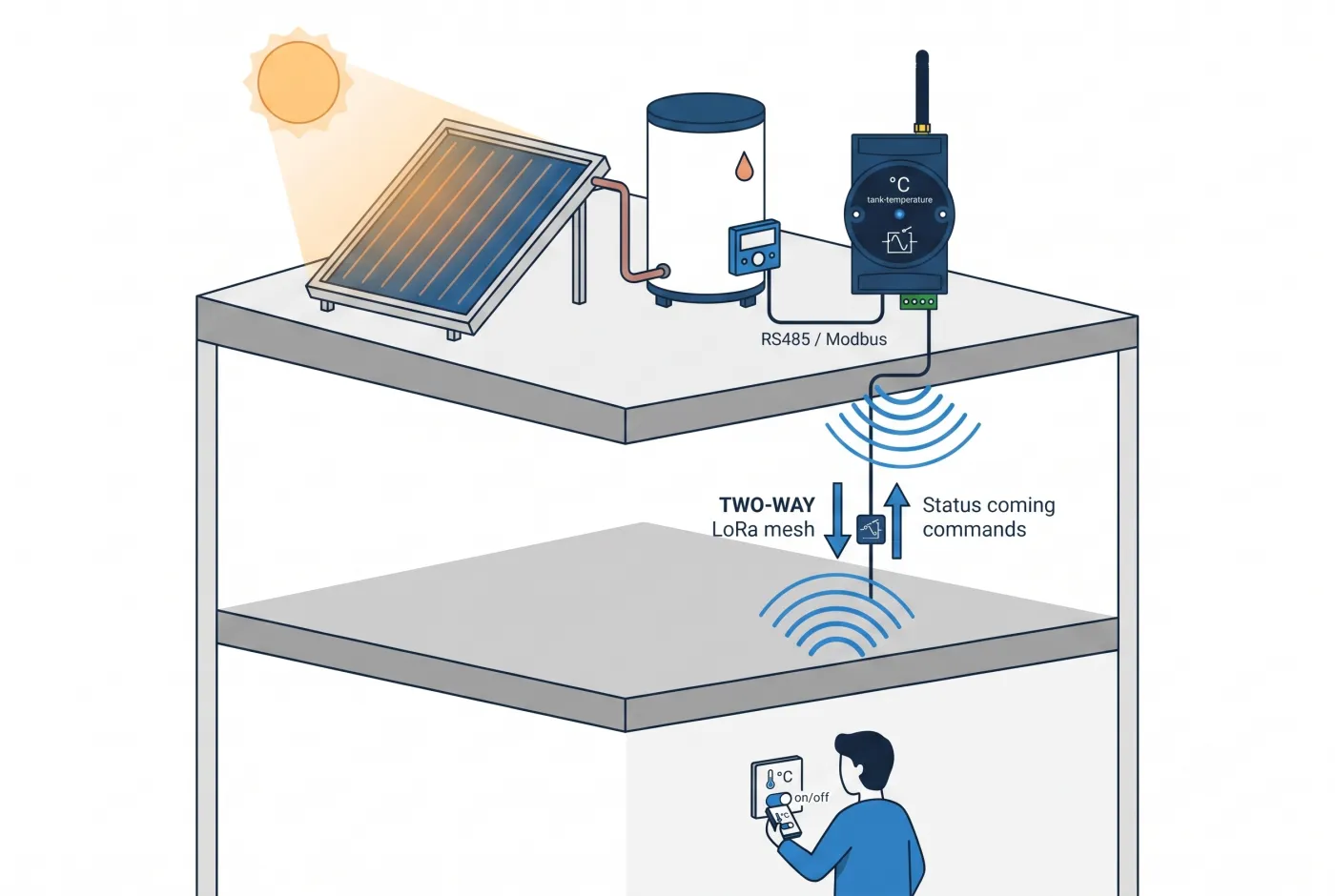
Yes. A node at the rooftop controller reads the status and drives a control output; a self-healing LoRa mesh carries it down into the house — and commands back up. No cable down the wall, no internet, and if the roof-to-room link is weak you just add a node.
Self-healing mesh Monitor + control No cable down the wall
Diagram: a rooftop solar water heater monitored and controlled indoors over a LoRa mesh

The situation

A solar hot water system sits on the roof — tank, collectors, a controller, maybe a booster pump or an electric backup element. The owner wants the tank temperature and status on a panel inside the house, and ideally to turn the backup or pump on and off from indoors. Running signal and control wiring from the roof, through the slab and down a wall into the living space, is invasive and ugly.

Why people assume it can't be done

The fear
“It's on the roof, behind a concrete slab. I don't want to chase cable down the wall, and I don't trust wireless to reliably switch something on and off.”
Part 1 — the radio
Sub-GHz LoRa (around 920 MHz in Taiwan) goes through a roof slab and a floor or two comfortably, and the link is two-way — so status comes down and commands go back up on the same mesh.
Part 2 — you're not betting on one hop
Because every Siliqs node meshes by default, a marginal roof-to-room link is fixed by placing one node on the way — a top-floor room, the stairwell. It relays automatically, so control stays reliable without you engineering the link.

How Siliqs solves it

One node on the roof, one indoors, a two-way mesh between them.

A node at the rooftop controller

It reads status — tank temperature, pump state — from the controller's RS485 / Modbus, or from added sensors, and has a controllable output to switch a pump or the electric backup.

A two-way mesh into the house

Status flows down and commands flow back up over sub-GHz LoRa — no cable through the slab. Add a relay node on the way if the link is weak.

Monitor and control indoors

An indoor receiver plus the free Siliqs Gateway app shows the status and sends commands back — on a phone, a panel, or into home automation via MQTT.

What if the roof-to-room link is weak?

Then you add a node on the way — and that's the whole answer.

Mesh is the default
Every Siliqs node joins the same mesh out of the box — you never design or switch on a network.
Adding a hop = adding a node
Put one node in a top-floor room or the stairwell. It only needs power, and it bridges the roof to the living space.
Two-way stays reliable
The mesh routes both the status coming down and the command going up, so control doesn't get flaky as you extend it.
It self-heals
If a node loses power the mesh re-routes on its own — no single link is a point of failure.

What you actually need

On the roof
A controller with RS485 / Modbus, or a temperature sensor plus a relay for control — the node reads status and switches an output.
Cabling
None into the living space. The link is wireless.
Infrastructure
No LoRaWAN gateway and no internet required — though it can bridge to home automation over MQTT if you want.
Devices
One node on the roof + one receiver indoors, plus a relay node on the way only if the link needs it.
On control
Honest note: monitoring works with any temperature source; control depends on what your system exposes — a relay-driven pump or backup element is straightforward, a proprietary controller may only allow read-only.
The node
SQC485Iv2 — LoRa RS485 industrial node.

Questions people ask

Can I monitor a rooftop solar water heater from inside the house without wiring?

Yes. A node at the rooftop system reads the status and sends it indoors over a self-healing LoRa mesh — no cable through the slab or down the wall.

Can I also control the pump or backup heater remotely?

Yes, where your system exposes control — the node has a controllable output to switch a relay-driven pump or electric backup, and the mesh link is two-way so commands go back up.

Does the signal get through the roof slab?

Sub-GHz LoRa handles a slab and a floor or two comfortably. If a particular building is marginal, add a relay node on the way and the mesh routes through it.

Do I need internet for this?

No. The link is self-contained. It can optionally bridge into home automation over MQTT, but it doesn't require the internet to work.

Can it handle more than one system or sensor?

Yes. Multiple rooftop points join the same mesh and report to one indoor receiver.

Got a rooftop system you want indoors?

Tell us the controller or sensor, whether you need control, and how many floors down. We'll tell you straight what's possible.