Application · Wireless power metering

“The power meter is two floors down in the basement. Can I read it upstairs without running cable?”

The honest worry is range: will one hop reach from B2 up to the monitor room? You don't have to gamble on it. Siliqs nodes form a self-healing mesh by default — if a single hop is marginal, you drop in another node in between and it relays automatically. No setup, no re-configuration.
Self-healing mesh No new cabling No PLC No internet needed
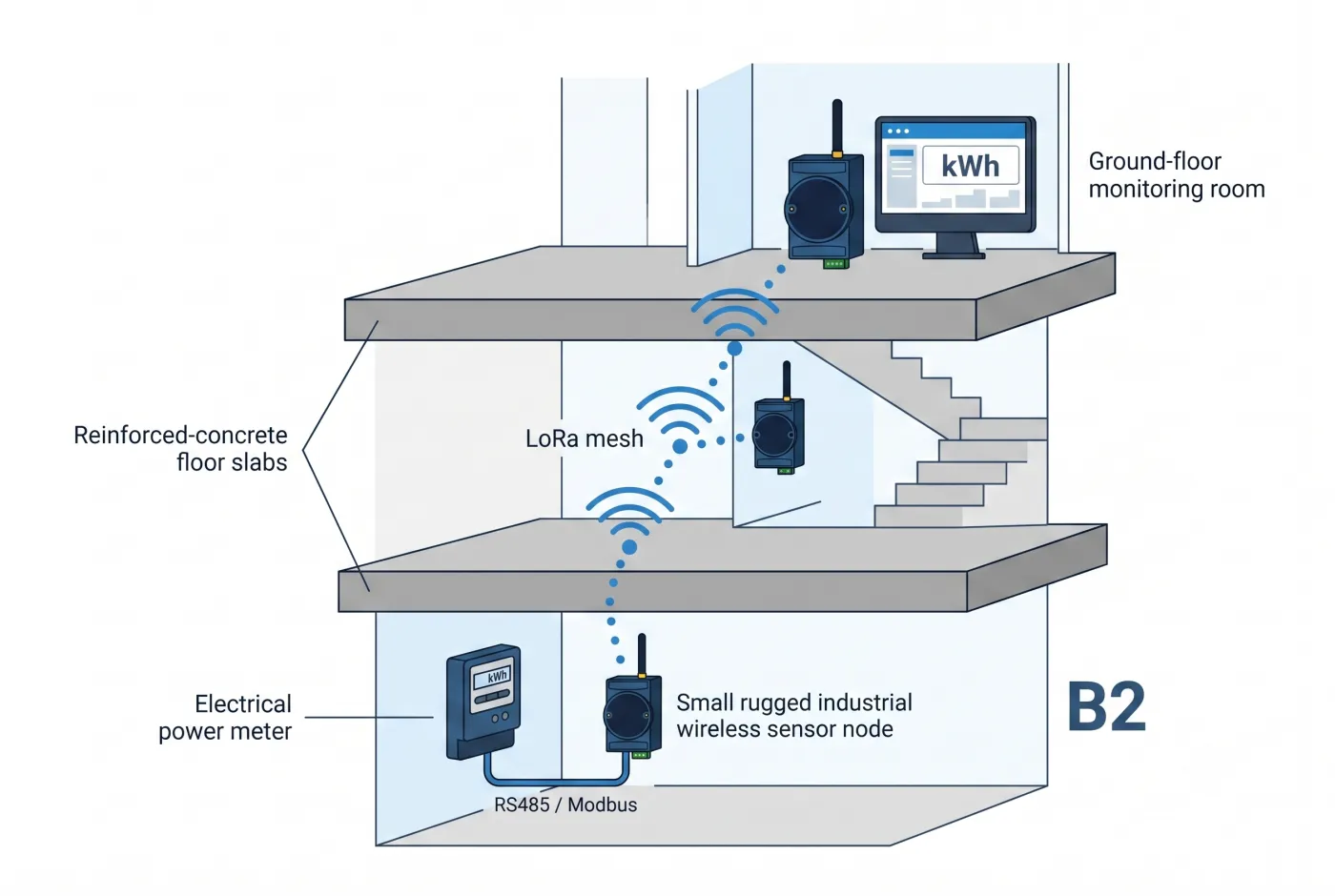
Diagram: a basement power meter read over a self-healing LoRa mesh up to the monitor room

The situation

A building or facilities manager has an energy meter sitting in the basement — a normal RS485 / Modbus RTU power meter. They want its readings at a desk on the ground floor: how much power is being drawn, kWh, maybe voltage and current. Between the two points are two floors of reinforced concrete. Pulling a new signal cable up the riser is disruptive and expensive, and Wi-Fi neither reaches nor stays reliable through that much concrete.

Why people assume it can't be done

The fear
“Can LoRa even cover two floors from B2 up to the monitor room? Concrete kills wireless — and I can't trust something flaky for a meter I have to read every day.”
Part 1 — the radio
Wi-Fi and Bluetooth run at 2.4 GHz, which concrete really does absorb. LoRa is a different animal: sub-GHz radio (around 920 MHz in Taiwan) at a very low data rate, built to punch through structure. Very often a single hop from the basement is already enough.
Part 2 — you're not betting on one hop
This is the real point. Every Siliqs node is a mesh node by default and the mesh self-heals. So you never have to gamble that one link is strong enough — if it's marginal, you add a node in the stairwell or a floor between, and the mesh routes through it automatically. Nothing to configure.

How Siliqs solves it

Two small boxes, a self-healing mesh, and no cable between the floors.

A node at the meter

A Siliqs node wires to the meter's existing RS485 terminals (A/B) and polls the Modbus registers you care about — kWh, power, voltage, current.

The reading rides the LoRa mesh up

Each reading is sent over sub-GHz LoRa — no new cable, no internet. Because it's a mesh, the data will hop across as many nodes as it needs to reach the monitor room.

A receiver in the monitor room

A second unit in the monitor room receives the data and hands it to a screen, a logging PC, or your MQTT / building system — using the free Siliqs Gateway app.

What if two floors is too far?

Then you add a node — and that's the whole answer.

Mesh is the default
You don't switch it on or design a network. Every Siliqs node already joins the same mesh out of the box.
Adding a hop = adding a node
If B2 → monitor room is marginal, place one more node somewhere in between — a stairwell, the B1 landing, an electrical closet. It just needs power.
Zero configuration
The new node relays automatically. You don't pair it, address it, or re-configure anything — the mesh discovers it and routes through it.
It self-heals
If a node loses power or a path degrades, the mesh re-routes on its own. No single link is a point of failure.

This is why you don't have to gamble on coverage: the worst case isn't “it doesn't work” — it's “add one more inexpensive node,” and it works.

What you actually need

Meter
Any energy or power meter with an RS485 / Modbus RTU interface.
Cabling
None between floors — only the short existing RS485 run to the meter itself.
Infrastructure
No LoRaWAN gateway and no internet required. The link is self-contained.
Devices
One node at the meter + one receiver in the monitor room to start. Add a relay node if a hop is marginal, and add more meters — they all join the same mesh.
Setup
Point-and-click in a web browser — no programming. Free Siliqs Flasher and Configurator.
The node
SQC485Iv2 — LoRa RS485 industrial node.

Questions people ask

Can a LoRa signal really reach from a basement to the ground floor through concrete?

Usually in a single hop, yes — LoRa uses sub-GHz radio (around 920 MHz in Taiwan) at a low data rate, which penetrates reinforced concrete far better than Wi-Fi or Bluetooth at 2.4 GHz. And you're not relying on one hop: the nodes form a self-healing mesh, so if a link is marginal you add a node in between and it relays automatically.

What if the signal doesn't reach in one hop?

You add a node in between — that's it. Siliqs nodes mesh by default, so a node placed in a stairwell or a floor between (it only needs power) relays the data automatically, with nothing to configure. The mesh also self-heals if a node drops.

Do I need to run any cable between the floors?

No. The only wiring is the short, existing RS485 connection to the meter. The link between floors is fully wireless.

What kind of power meter does this work with?

Any energy or power meter that has an RS485 / Modbus RTU interface.

Do I need a LoRaWAN gateway or an internet connection?

No. The link is self-contained — a node at the meter and a receiver on the ground floor. No LoRaWAN network server or internet is required.

Do I have to write firmware or code?

No. The node is flashed and configured from a web browser with free Siliqs tools — you set the meter's Modbus poll plan by point-and-click.

Can I read more than one meter?

Yes. Additional meters can be added on the same wireless link, with multiple nodes reporting to one receiver.

Got a similar situation?

Tell us the meter model and roughly how far / how many floors between it and where you want the reading. We'll tell you straight whether it'll work.